
Digital Certification Management Platform
What the CMP is
The Digital Certification Management Platform, called the CMP, is a web application for safety-training classes and the certificates that come out of them. It records each class, issues a numbered certificate to every student who qualifies, emails it to them as a PDF, and lets anyone check it later.
Certificates are digital only. Each one is a PDF delivered by email, with a wall certificate and a wallet card on two pages.
An instructor or training company enters who attended a class and how they did. The platform checks the record. Each student who qualifies receives their certificate by email. The platform tracks the expiry date and emails the student about 60 days before it arrives.
The CMP records training that happens elsewhere. It does not deliver course content.
What it does
Select a feature to jump to its section.
The platform in numbers
All time
58
Training providers
Employer of an instructor that has delivered training
75
Instructors
Instructors who have taught a published class for those organizations
5,016
Students trained
Students that have received training in at least one Haland course
7,650
Certificates issued
Some students have received more than one certificate
Figures from the Haland certification platform as of October 8, 2026. Haland's own classes are not counted.
Training records
-
The class is recorded
An instructor, training provider or administrator records the class: the course and version, the date and times, the instructor, and the students. A class can be saved as a draft and finished later. Students can add themselves by scanning a QR code on a draft class.
-
Results are entered
For each student, the person recording the class enters the theory score, the practical result, and pass or fail. The theory score cannot be higher than the course maximum.
-
The record is checked
When the class is published, the platform checks every student. The certificate number must belong to the same training provider, and the theory score must fall inside the course's allowed range. Students who pass the checks are verified and their certificates are issued. Anything that doesn't pass goes to an administrator, who verifies it, rejects it or corrects the certificate number.
Certificates
-
Issued
Each certificate carries the class date as its issue date, and an expiry date set by the course's validity period. The default is 3 years.
-
Delivered by email
The instructor, provider or an administrator sends certificates by email: one student, a selection, or the whole class. The PDF is attached. It is A4, two pages, a wall certificate and a wallet card, with the instructor's signature and a QR code. A student who did not pass gets a notice email and no certificate.
-
Downloaded
Students can sign in and download their own certificates. Instructors, providers and administrators can download one certificate or many. A batch of up to 1,000 comes as a zip, with a link emailed to the requester that is valid for 7 days.
Verification
The public verification page needs only the certificate number and the holder's last name. The QR code on the certificate opens the result directly. The result shows the student's name, the certificate number, the course, the issue and expiry dates, the training provider, the instructor, and a partly hidden email address. The page offers a download of the PDF or a copy sent by email. Each successful lookup is recorded.
Expiry reminders
A daily job emails each student once, when a verified certificate is within 60 days of expiring. Training providers see an Expiring soon alert and filter on their dashboard. Providers and instructors also receive a monthly summary email of classes delivered, students trained, certificates issued and certificates expiring within 60 days.
Marketplace
Training providers, and instructors a provider has permitted, order course activations in the marketplace. They choose the course and quantity and check out for pickup or shipping. Payment is by card, or on 30-day terms where an administrator has enabled that.
Price depends on quantity. Each course version has quantity tiers, and the unit price for the tier an order falls into applies to every unit on that line.
Providers set a low-stock warning threshold for each course. An email goes to administrators and providers when stock is at or below it.
Provider dashboard
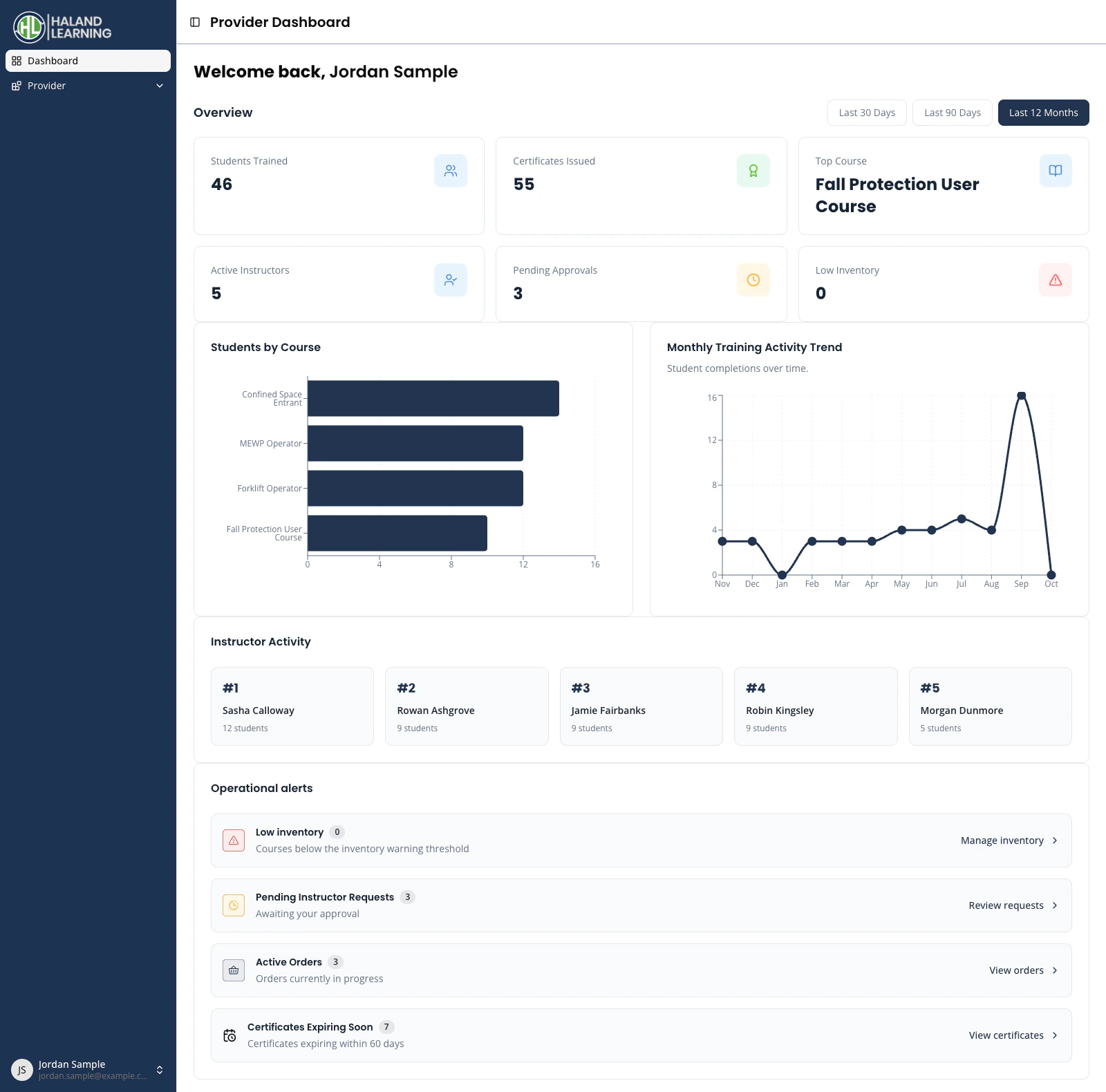
The provider dashboard shows students trained, certificates issued, the top course, active instructors, pending approvals and low inventory, with a monthly trend, instructor activity and operational alerts.
Instructors and resources
Training providers see their instructors and choose which of them may place orders. An instructor can work for several training providers.
Administrators upload instructor resources, which are exam answer keys and competency evaluations, for each course version. Instructors download the resources for the courses they are approved to teach.
Courses and versions
Administrators manage courses and their versions. Each certificate records the version it was issued under, and prints that version's name, topics and duration.
Who does what
Instructors
Record classes and enter results. Send and download certificates. Download instructor resources, which are exam answer keys and competency evaluations, for the courses they are approved to teach. An instructor can work for several training providers.
Training providers
See a dashboard of students trained, certificates issued, top course, active instructors, pending approvals and low inventory, with a monthly trend. Record classes, send and download certificates, and see their instructors. Choose which instructors may place orders. Order course activations in the marketplace.
Students
Receive their certificates by email, and see them in their own account with issue and expiry dates and a download button.
Anyone checking a certificate
No login is needed. Use the public verification page.
Administrators
The platform operator's staff. They review and verify records, correct certificate numbers, manage courses and course versions, upload instructor resources, and fulfil orders.